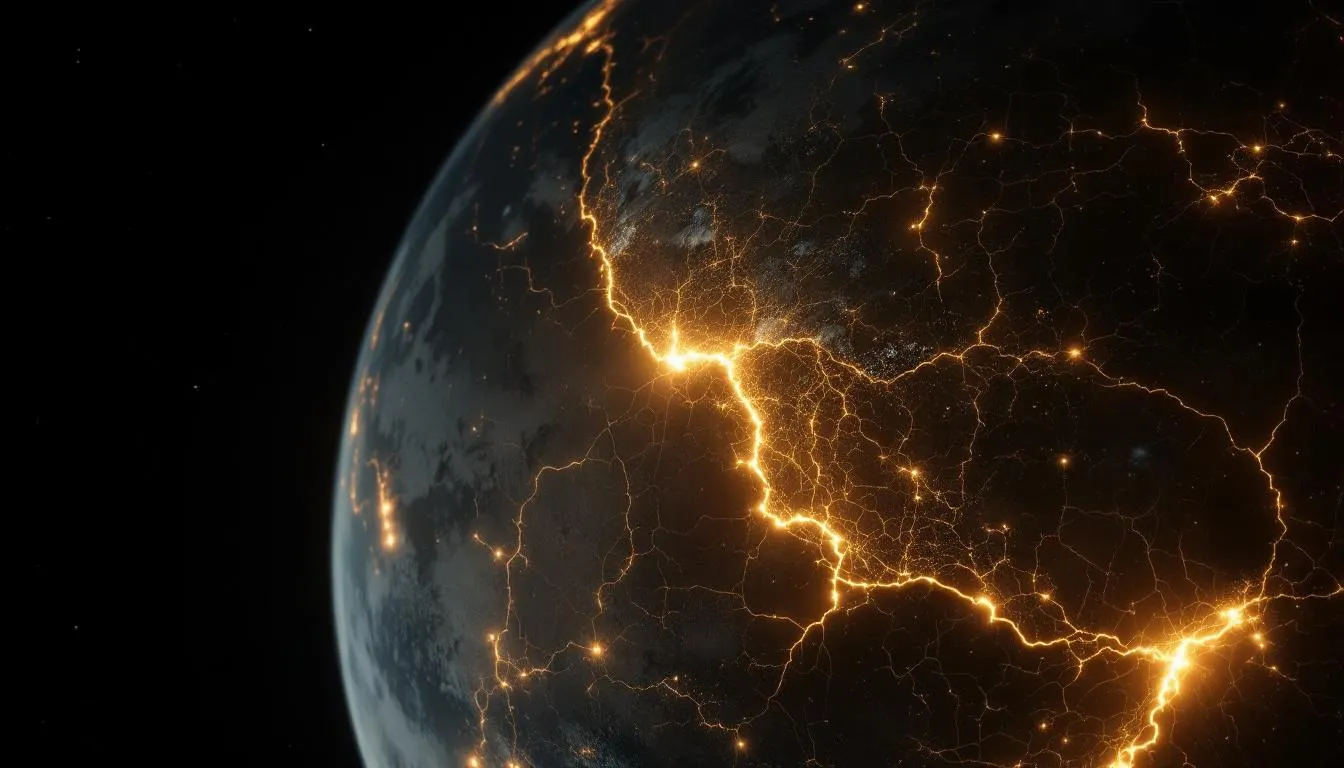
Most dystopian novels about emotional suppression keep their stakes personal: one person wakes up, fights the system, and wins or loses their freedom. I wanted The Emotion Collector: Awakening to go further. The question I kept asking while writing was: what if suppressing human feeling did not just damage people but damaged the planet? What if the Earth itself was aware, and what if human emotion was the language it used to stay alive?
Quick Answer: The Emotion Collector: Awakening proposes that human emotions function as biological connections between consciousness and the planetary ecosystem, making emotional suppression a form of ecological collapse.
Definition: Emotion Collector planetary consciousness is the idea that the Earth possesses awareness sustained by human emotional energy, and that severing those connections kills the world as surely as cutting a nerve kills a limb.
Key Evidence: Dr. Clarke's research shows direct correlation between suppression expansion and ecological decline: crop failures, species extinction, and weather instability all accelerating in lockstep with dampening upgrades.
Context: I built this concept because I wanted the stakes of suppression to extend beyond psychology. If feeling is connected to the living world, then suppression is not just political. It is existential.
This article covers how Emotion Collector planetary consciousness works in the story and what it means for the novel's larger argument about the cost of suppression.
How Planetary Consciousness Works in the Story
Dr. Clarke's hidden laboratory beneath New Geneva contains the evidence that changes everything. His research, conducted over fifteen years in secret, shows that human emotions generate electrical activity connecting individual consciousness to planetary systems. Love for a child strengthens the soil where flowers grow. Grief for the dead nourishes cycles of renewal. Joy in music makes the natural world respond in kind. These are not metaphors in the novel. They are measurable biological processes that the Council's suppression technology has been severing for over two centuries.
When Clarke shows Emma the data, the implications hit her with physical force. Every emotion she collected was a thread in a living network, and every extraction she performed cut another connection between human awareness and the Earth's capacity to regulate itself. The planet is dying of loneliness: a vast, patient, aware system reaching out for human contact and finding nothing but silence.
I chose to make the planetary consciousness feel lonely rather than angry because I wanted it to mirror the condition of the suppressed humans above. The citizens of New Geneva are not violent or chaotic. They are hollow, numb, going through motions that look like living but feel like nothing. The planet below them is experiencing the same thing at a geological scale: systems that still function but are losing their coordination, their purpose, their connection to the conscious life that once sustained them.
Biologically, the mechanism is not magical. Emotions generate fields that interact with the planet's electromagnetic systems. When billions of people feel authentically, those fields create a network the Earth uses to coordinate ecological functions. Suppress them, and the network goes dark. The result is slow degradation over centuries, which is why the Council never noticed.
What Planetary Consciousness Reveals About the Novel's Argument
Emotion Collector planetary consciousness serves a specific structural purpose in the book. It raises the stakes from personal freedom to species survival. Without this layer, the novel would be a story about one woman choosing to feel in a world that forbids it. With it, Emma's choice becomes a choice about whether all life on Earth continues to exist. I needed that escalation because the book's argument, that suppressing emotion is always more dangerous than feeling it, required consequences large enough to match the claim.
The concept also reframes how the reader understands the Council. Without the ecological dimension, the Council is an authoritarian government suppressing its citizens for control. With it, the Council is a system killing the planet while sincerely believing it is saving civilization. That distinction matters because real institutions that cause environmental damage rarely act from malice. They act from good intentions, incomplete data, and an inability to see consequences that unfold on timescales longer than a single career.
Emma's transformation at the novel's end is where the concept pays its full cost. She does not just stop the suppression system but becomes the bridge between human consciousness and planetary awareness, dissolving her individual identity into the global emotional field so that connections can be restored permanently. The planetary consciousness is not saved by a political act or a technological fix. It is saved by a person who agrees to become part of it, trading her individual life for the life of the world. I wrote that ending because the concept demanded it: if emotion is the connection between people and the planet, then restoring it requires someone willing to become that connection entirely.
Why Planetary Consciousness in The Emotion Collector: Awakening Matters
This concept matters because it proposes that human feeling is not a private luxury but a biological responsibility. If the way we treat our emotions affects the world beyond our own minds, then numbness is not neutral. It is negligence on a planetary scale.
Conclusion
Emotion Collector planetary consciousness turns a story about personal freedom into a story about ecological survival. The question it asks is whether humanity can afford to treat its own feelings as disposable, and the answer is that the planet cannot survive if we do. Explore the full story at theemotioncollector.com.